
A recovery-grounded civic reflection by Lawrence Jay Long
When I wrote previously about Desiderata by Max Ehrmann, recovery wisdom on election night, and even transforming fear into freedom in challenging times, I was trying to practice what recovery has taught me: acceptance is not apathy, peace is not denial, and serenity is not the same thing as surrender.
Those truths still matter to me. Maybe more than ever.
And so does another recovery truth: community heals, isolation divides.
“Speak your truth quietly and clearly.”
Max Ehrmann, Desiderata
After Desiderata, without surrender
Why silence is no longer an option
I never believed any of this was normal. I never believed cruelty, corruption, grift, and authoritarian posturing were somehow part of a healthy civic life. What has become harder to ignore, though, is not only Trump himself, but the system of people around him who continue to excuse, enable, sanitize, and enforce his behavior at the highest levels of government.
That is where my attention is now. Not primarily on ordinary voters, many of whom are carrying pain, frustration, exhaustion, and legitimate distrust of broken institutions. Human beings are more complicated than partisan caricatures, and recovery has taught me to resist flattening people into cartoons. My deeper concern is with those in Congress, in the cabinet, in party leadership, and across the wider machinery of power who know better and continue to cooperate anyway.
Because recovery has also taught me something else: rigorous honesty.
And rigorous honesty requires saying this plainly. Whatever hope some once projected onto Trump, the reality now in front of us is failure wrapped in propaganda and protected by cowardice. He promised affordability, stability, strength, and peace. Instead, the country is absorbing another energy shock, another wave of fear-based governance, another season of legal chaos, and another round of demands that we deny what we can plainly see.
Trump is not doing this alone. He is being enabled by people who know better and continue anyway — people who trade truth for access, conscience for ambition, and public duty for political survival. That betrayal may be even more dangerous than Trump himself. One reckless man is a crisis. A governing class that keeps choosing to protect him is a moral collapse.
Why Trump’s affordability promise has collapsed
Start with affordability, because that was supposed to be the easy promise. Americans were told life would get cheaper, calmer, and more secure. Instead, families are staring at rising fuel costs, renewed inflation fears, and another round of economic anxiety. Working people do not experience this as a policy debate. They experience it in gas stations, grocery aisles, utility bills, and the quiet dread that the next month will cost more than this one.
That is not relief. That is not stability. That is not competent stewardship. It is a political sales pitch colliding with reality.
For ordinary people, this is where the lie becomes impossible to dress up. When energy costs rise, everything else follows. Food moves on trucks. Goods move through supply chains. Households already stretched thin do not need another round of geopolitical gambling by men who will never miss a meal. They need steadiness. They need restraint. They need leaders who understand that the price of swagger is usually paid by someone else.
Instead, we are once again being told to trust spectacle over substance, slogans over evidence, and grievance over responsible governance.
How war abroad is hurting families at home
And why is that happening? Because the man who sold himself as a brake on reckless war helped launch one. The same figure who marketed himself as the alternative to endless foreign-policy stupidity has once again helped move the world closer to wider conflict, greater disruption, and more pain for ordinary people.
This is not some abstract geopolitical chess match. It lands in freight costs, food prices, retirement accounts, and household stress. It lands in the nervous systems of families who were already exhausted. It lands in the daily life of people who do not have the luxury of pretending foreign policy is separate from rent, groceries, or survival.
That is what happens when slogans collapse and consequences arrive.
There is something especially grotesque about watching politicians posture as strong while ordinary people absorb the fallout. It is one thing to speak recklessly. It is another to gamble with global stability while insisting you alone are the adult in the room. That is not peace through strength. It is insecurity armed with power.
Why force without justice is not order
This is where I need to be clear: I am not interested in pretending every promise failed in exactly the same way. Border crossings did fall under Trump’s crackdown. That part is real. But the moral and legal cost has been staggering. The same machinery supporters point to as proof of “order” has also produced due-process abuses, detention battles, wrongful-arrest claims, and a growing collision with the courts.
That is not law and order. That is brute force followed by legal cleanup.
When a government normalizes cruelty, secrecy, and procedural abuse in the name of security, it does not restore order. It corrodes it. It trains the public to confuse domination with safety. It teaches people to tolerate injustice as long as it happens to somebody else. And once that habit sets in, no one should feel secure.
Minnesota has become one of the clearest examples of that cost. What happened there should stop any decent person cold. A government that promised safety and control has instead produced death, secrecy, and a fight over accountability. Even if you strip away every overheated phrase and stick only to what can be responsibly said, the picture is ugly enough. When the state operates through fear, opacity, and coercion, trust erodes fast. And once trust goes, the damage spreads far beyond the immediate victims.
Why image management is not leadership
The administration’s contempt for scrutiny has shown up elsewhere too. This is a governing style obsessed with controlling the story, disciplining access, and punishing dissent. That is not the behavior of confident leadership. It is the behavior of people who know their strongest weapon is image management.
They want performance in place of truth. Spectacle in place of competence. Loyalty in place of accountability.
This is one of the most dangerous features of the present moment. Too many people have learned to interpret confidence as credibility. They hear a firm voice, a hostile soundbite, a smirk on television, and mistake it for seriousness. But governance is not cable news. Leadership is not branding. A nation is not a stage for a wounded man’s self-mythology.
When power becomes addicted to optics, truth becomes expendable. And once truth becomes expendable, every abuse gets easier.
Why character still matters
And no, I do not think character is some side issue we can keep brushing aside because politics is supposedly only about outcomes. Character matters. It always mattered. It mattered when people tried to minimize Trump’s lying. It mattered when people treated cruelty as mere style. It mattered when decency itself became something to mock.
I want to be careful here. A felony record is not, by itself, proof that a person is beyond redemption. Plenty of people with records do the hard work of accountability, repair, humility, and real change. Many returning citizens show more honesty and courage in rebuilding their lives than Trump has shown in a lifetime. That is exactly why I refuse to use “felon” as a stand-in for human worth. In fact, it makes me think of the work my colleague Fred Dent is doing through Second Chances, helping returning citizens break free from the second prison of stigma and limited opportunity through support, practical help, and community. That is what accountability paired with hope can look like.
Trump is not that. He was convicted on 34 felony counts and found liable for sexual abuse and defamation, yet he remains proudly unrepentant — incapable of truth, incapable of accountability, and seemingly allergic to remorse. He is not an example of redemption. He is an example of incorrigibility. So when people continue to speak about him as if he is some unfairly maligned champion of virtue, I do not hear seriousness. I hear denial.
At some point, the hypocrisy becomes too obscene to ignore.
The same people who once wrapped themselves in the language of morality, family values, law and order, and personal responsibility have spent years excusing lies, corruption, sexual abuse findings, criminality, and public cruelty because it serves their politics. That disgusts me. It should disgust anyone with a functioning conscience.
Why truth should not be negotiable
On the Epstein files, I want to be disciplined. I am not going to claim I can prove motives I cannot prove. I cannot say with certainty that Trump is risking the world in order to distract from what may still come to light. But I also refuse the opposite lie, which is that there is nothing there to ask about.
There are reasons for serious people to demand transparency, lawful disclosure, and a full accounting wherever the facts lead. Recovery does not ask us to replace one form of dishonesty with another. It asks us to bring secrets into the light. It asks us to stop bargaining with the truth.
That is the line I keep coming back to now. I can still distinguish between good people who once supported Trump and people who continue to apologize for what is plainly in front of them. Those are not the same thing. There is a difference between being misled and becoming an apologist. There is a difference between disappointment and delusion. Once the war, the costs, the legal abuses, the deaths, the secrecy, and the grift are this visible, ongoing excuse-making stops looking like political loyalty and starts looking like moral surrender.
Community heals, isolation divides.
What we do next matters
So what do we do with that?
We do not give ourselves over to hatred. We do not let outrage become a substitute for action. We do not become spiritually hollow while calling it awareness. We tell the truth, we refuse the lies, and then we put our hands to work where we actually live.
This matters especially in recovery communities, because we know what it looks like when anger masquerades as wisdom. We know what it looks like when resentment dresses itself up as moral clarity. We know what happens when people become so consumed by what is wrong that they stop being useful.
That is not sobriety. That is not freedom. That is not spiritual health.
If we are going to resist what is happening, we need to do it in a way that keeps us human.
Why we need to bring the world back down to the neighborhood
One of the most healing things I have learned in recent years is that when the world becomes too large, too violent, too manipulative, and too absurd to carry all at once, it helps to shrink your field of responsibility back down to the neighborhood.
I do not mean that we stop caring about what is happening overseas or in Washington. I mean we stop pretending that our only meaningful choices are national. There is a massive relief that comes when you admit you cannot personally control what is happening in Iran or inside the White House, but you can still help feed somebody, mentor somebody, visit somebody, support somebody, or help hold a family together.
There is serenity in that.
Not passive serenity. Active serenity. The kind that comes from service.
There is also honesty in it. Much of our despair comes from trying to inhabit a scale of power that was never ours. We are flooded with headlines, images, threats, lies, and manipulations from every direction. The machine wants us overwhelmed. It wants us numb. It wants us angry but inert. Shrinking the world back down to the neighborhood is one way of refusing that.
How service becomes one way out of helplessness
That is part of why I have thrown myself into nonprofit work. Not because nonprofit work makes a corrupt administration disappear. It does not. Not because local service solves war, propaganda, grift, or authoritarian drift. It does not. But because service gets me out of helplessness. It gets me out of doom. It gets me back into relationship with actual human beings. It reminds me that in a time of spectacle and manipulation, there are still ordinary, grounded, decent things we can do for one another.
For people in recovery, that matters. Service interrupts self-obsession. It interrupts despair. It puts flesh on principles like honesty, humility, community, and respect for the higher power of others.
There is a reason service has always had such power in recovery spaces. It changes the scale of the self. It reminds us that we are not the center of the story. It restores proportion. It cuts through paralysis. It gives the heart somewhere to go besides fear.
When I say service is healing, I do not mean it sentimentally. I mean it concretely. The body settles. The mind clears. The spirit remembers what it is for.
Why neighborism is a form of resistance
I think of the way neighbors responded in Minnesota under pressure. Not with passivity. Not with polished branding. Not with empty rage online. But with rides, food, legal support, mutual aid, and local solidarity. That is the spirit I mean. Neighborism.
The stubborn insistence that when larger systems become cruel or untrustworthy, ordinary people can still choose to become more human, not less.
There is not one way to fight it.
That line matters. There is not one way to fight it. Some people will march. Some will write. Some will organize. Some will donate. Some will show up quietly and consistently for the people most likely to be crushed by the system as it is currently operating.
All of that matters.
Neighborism is not soft. It is not naive. It is not retreat. It is one of the oldest forms of resistance there is: refusing to let fear and domination have the final word in how we treat one another.
How to serve your Spokane neighbors right now
Here in Spokane, that can mean real things.
It can mean Spokane Fatherhood Initiative, whose work is rooted in restoring the value of fatherhood so that children have present, loving, and nurturing fathers. It can mean Second Harvest, where volunteers sort food, pack boxes, and help in the kitchen so food reaches people who need it. It can mean Reclaim Project Recovery, which helps men move away from addiction, incarceration, and homelessness through purpose, community, shelter, and recovery-oriented support.
It can also mean SNAP, which serves neighbors across Spokane County through programs that strengthen stability and dignity. It can mean Vanessa Behan, whose work helps keep children safe and strengthen families in crisis. It can mean Meals on Wheels Spokane, where volunteers deliver meals and check in on seniors. It can mean Spokane Helpers Network, which brings food and essentials directly to financially struggling neighbors across Spokane County.
Those are not abstractions to me. Those are real avenues for healing work.
And there are many more. The point is not that everyone must choose the same organization. The point is to choose something. Choose a place where your hands, time, money, attention, or skills can reduce suffering and strengthen human dignity close to home.
Where to put your hands to work in Spokane
- Spokane Fatherhood Initiative — volunteer opportunities in event support, mailings, clerical help, prayer, fundraising, and community engagement.
- Second Harvest Inland Northwest — sort food, pack boxes, or help in the kitchen so food gets where it needs to go.
- Reclaim Project Recovery — support recovery work for men through programs, resources, sober living, employment, and volunteer opportunities.
- SNAP — support neighbors through Spokane County programs focused on stability, opportunity, and dignity.
- Vanessa Behan — help create safe, nurturing support for children and families in crisis.
- Meals on Wheels Spokane — deliver meals and check in on seniors in the community.
- Spokane Helpers Network — deliver food and essential items directly to financially struggling neighbors.
How local action changes the scale of despair
I am not saying everybody has to join the same cause. I am saying this: if you feel powerless over what is happening in D.C. or overseas, do not underestimate the relief that comes from taking responsibility for your block, your town, your community, your food bank, your recovery house, your school, your shelter, your elders, your kids, your neighbors.
When you help somebody nearby, the nervous system settles. The lies lose some of their power. You remember that the country is not only made of presidents and pundits. It is also made of people carrying groceries, mentoring dads, stacking boxes, answering hotlines, driving meals, sponsoring newcomers, and showing up when no camera is watching.
That shift matters. It does not erase the larger crisis, but it does keep the larger crisis from colonizing your entire interior life. It gives you a way to remain morally awake without becoming emotionally destroyed. It reminds you that the world is still made, in part, by how we treat the people nearest to us.
Why protest matters, but is not enough
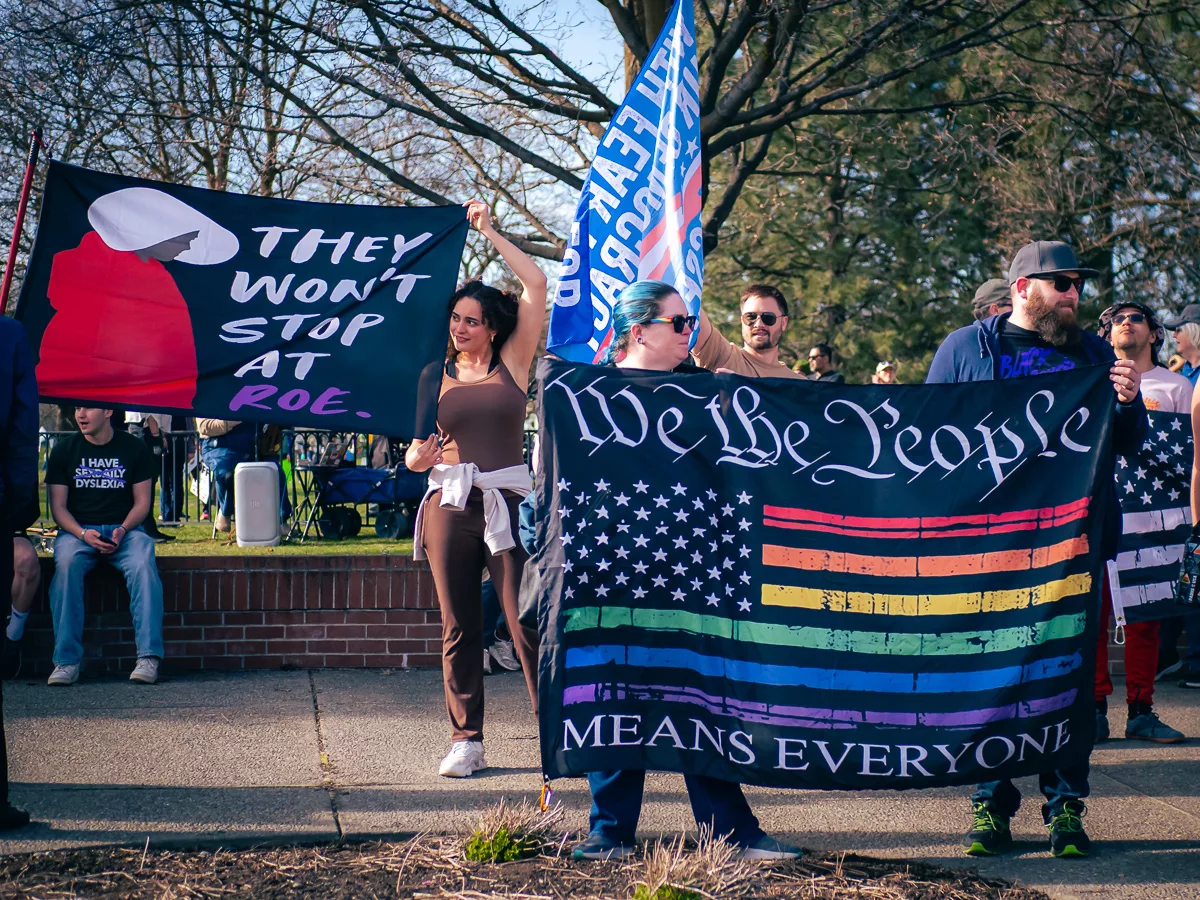
That does not replace protest. It strengthens it. It does not replace civic resistance. It grounds it.
Yes, mass demonstrations matter. Yes, public truth-telling matters. Yes, legal resistance matters. But sustained change requires more than one march or one post or one furious week. It requires durable local relationships, real mutual aid, organized service, and a refusal to let our public conscience be outsourced to politicians or pundits.
If protest is all we do, we burn out. If outrage is all we cultivate, we become brittle. If our politics never enters our neighborhoods, our institutions, our service, and our relationships, then even our most righteous anger becomes thin and performative.
We need depth. We need endurance. We need one another.
How to refuse the lie without losing our humanity
So this is where I land now.
I do not hate every person who voted for Trump. I do not think contempt is medicine. I do not think despair is wisdom. But I do think there comes a time when moral clarity requires us to stop making excuses. There comes a time to say: this is cruel, this is corrupt, this is dangerous, and I will not comply with the lie that it is normal.
And then, because outrage alone is barren, there comes a second step: go serve.
- Feed somebody.
- Mentor somebody.
- Give money.
- Give time.
- Join a board.
- Pack a box.
- Drive a route.
- Show up for a father, a child, a senior, a family, a person in recovery, a neighbor who is one bad month away from collapse.
That is one way I know to stay sane.
That is one way I know to remain useful.
That is one way I know to honor both recovery and democracy without worshiping either ideology or power.
We can reject the grift without becoming consumed by it. We can tell the truth without surrendering to bitterness. We can respect the higher power of others without bowing to a strongman. We can refuse compliance and still remain humane.
Without surrender
“As far as possible without surrender.”
Max Ehrmann, Desiderata
That is still the line for me.
Without surrender to fear. Without surrender to lies. Without surrender to cruelty. Without surrender to helplessness. And without surrender to the temptation to believe that nothing decent can still be built where we live.
It can.
We should build it anyway.
Start local. Stay human.
If the national picture feels overwhelming, serve somebody nearby. Support a Spokane nonprofit. Volunteer once a month. Give what you can. Let service bring your life back down to the scale of a neighborhood.
And if you want to stay connected to this work through nEveresting Recovery, join the community here or reach out directly.
